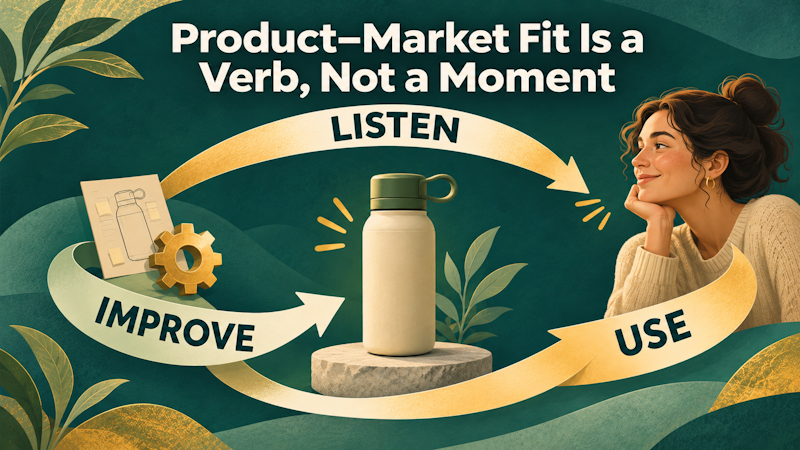
Product–market fit is a verb, not a moment
Product–market fit is an ongoing relationship between what you offer and what people need. Finding it matters. Continuing to earn it matters just as much.
Founders often talk about product–market fit as though it were a finish line.
You build something, people buy it, and one day you can say, "We found it." From there, the job appears to be scaling what works.
But customers change. Their circumstances change. Competitors introduce new choices. A product that solved a pressing problem last year may feel less useful today — even if nothing about the product itself has changed.
Product–market fit is an ongoing relationship between what you offer and what people need. Finding it matters. Continuing to earn it matters just as much.
The first sale is a beginning
An early sale tells you that someone was willing to try your offer. A second purchase, a referral, or continued use tells you more. So does a customer who stops using it.
Each interaction can reveal a different part of the story. Did the product solve the problem the customer thought they had? Was it easy enough to use? Did it fit into their daily life? Did they receive enough value to make the price feel worthwhile?
Those answers are rarely identical across customers. The founder's task is to look for patterns without losing sight of the people behind them.
This is particularly important for a purpose-driven business. A compelling mission may persuade someone to try a product once. To make a lasting difference, the product still has to work for that person.
A customer cannot benefit from an idea they find too confusing, too expensive, or too difficult to use.
Listen to what people do
Founders naturally want feedback, and customers are often generous with suggestions. But a suggested feature is not always the underlying need.
Someone might ask for more information when they really need a simpler first step. They might ask for a lower price when they are unsure what value they will receive. They might say they love the concept and never use the product.
It helps to ask what happened before the suggestion:
- What were they trying to accomplish?
- Where did they hesitate or stop?
- What did they use instead?
- What changed after they tried the product?
- Would they come back or recommend it?
The goal is not to follow every request. It is to understand the problem well enough to make better choices.
Fit changes as you grow
A product can fit an early group of enthusiastic customers and struggle with the next group. Early adopters may tolerate extra steps because they believe in the idea. A broader audience may expect the experience to be clear and reliable from the start.
Growth can also change what customers are buying. The personal guidance that made the first hundred customers happy may be hard to deliver to the next thousand. A feature that was useful on its own may need to work within a larger service or partnership.
These changes are easy to mistake for a marketing problem. Sometimes more people simply need to hear about the product. At other times, people hear about it and understand it, but the offer does not quite fit their lives. More promotion will make that gap more visible.
That is why product and marketing have to stay in conversation. Marketing brings people to the offer and reveals what they expect. Product determines whether the experience fulfills that expectation.
Keep earning the fit
This does not require a company to reinvent its product every month. Constant change can be as frustrating to customers as refusing to change at all.
It requires a habit of paying attention. Notice who benefits most and why. Look at where people leave. Learn what they return for. Be willing to improve the product, its presentation, or the way it is delivered when the evidence points there.
The strongest signal may be simple: people make room for the product in their lives because it helps them do something that matters.
Product–market fit is not a certificate a company receives once. It is work the company keeps doing: listening, learning, adjusting, and earning the customer's next yes.